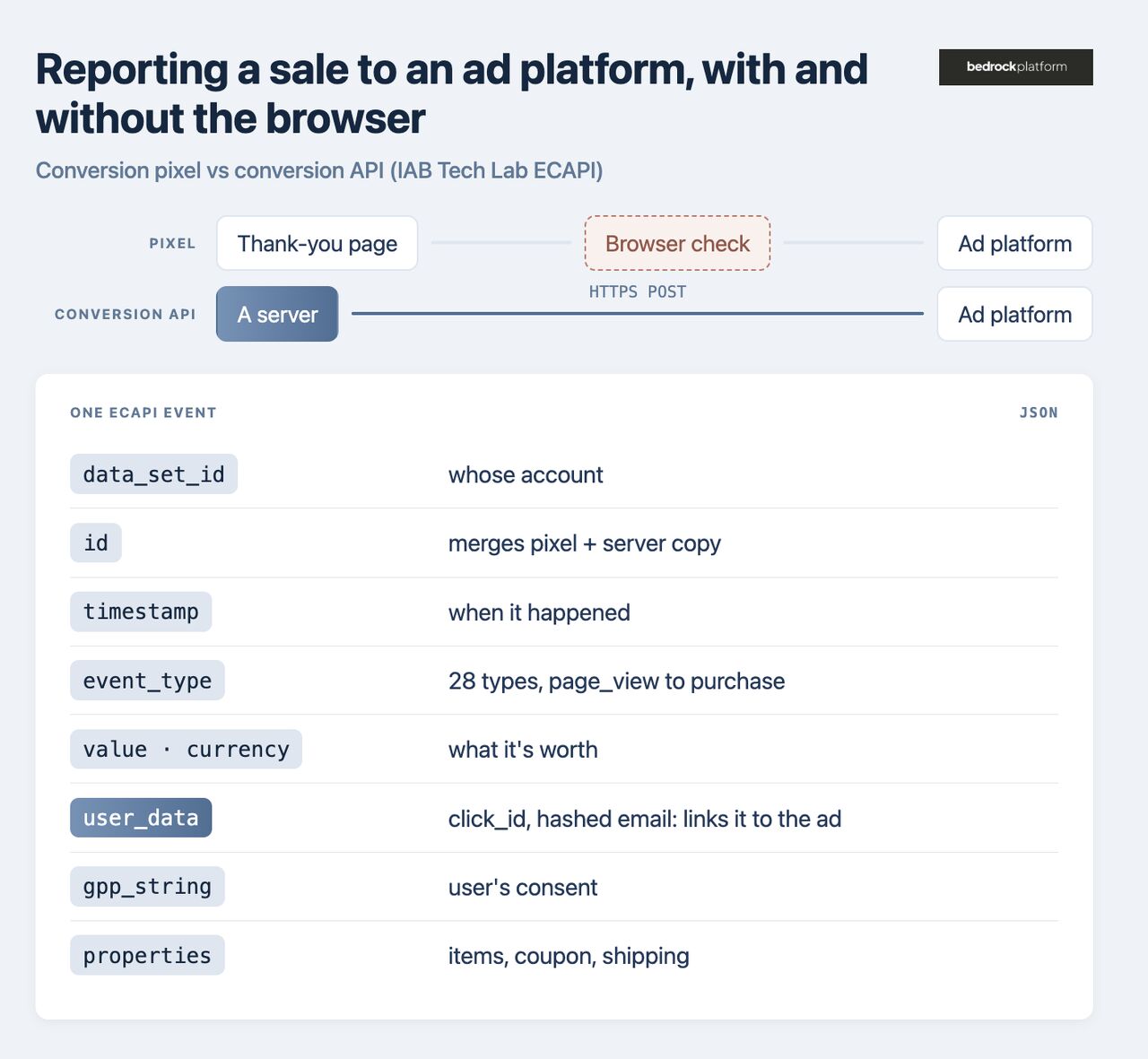
This month Safari began refusing some ad-tech requests before they leave the device. Most talk is about tracking IDs, but a conversion pixel is that kind of request too. A conversion API sends it from a server, where the browser takes no part.
Inside WebKit, a request from a page to another domain is refused when that domain is on a list Apple keeps (more on WebKit’s network process in my post from 15 October). If an advertiser puts a buying platform’s conversion pixel on shop.com, the request goes to that platform’s domain, so only the list decides. In an independent test on Safari 27.2 the pixels of the large ad platforms still went through, and only identity vendors were blocked. The check reads nothing but the domain, and the WebKit tracking policy lists ad measurement among the things its protections may affect. The pixels that go through already carry less, because cookies written by scripts live seven days and click IDs are removed from some links.
A conversion API moves the same event to the server. IAB Tech Lab’s Event & Conversion API (ECAPI) is the spec for it: how an advertiser’s server reports events to the ad platforms it buys on, so they can measure campaigns and optimize toward results. After the purchase, the shop’s server sends the event as JSON straight to the platform’s server with an HTTPS POST, one at a time or in batches. No browser takes part in that call, so no engine rule or blocklist can see it or stop it. Version 1.0 defines one shape for every platform: an account (data_set_id), an event id, a time, the value with its currency, user_data, and one of 28 standard event types that cover the whole funnel, from page_view and add_to_cart to purchase and qualify_lead. A properties object adds the details, such as the items, the coupon or the shipping cost.
The platform still has to link the purchase to an ad, so user_data carries what it can match on: the click_id from the ad click, or an email and phone number, normalized and hashed with SHA-256. When the pixel and the server both report the same purchase, both carry the same id and the platform merges them into one. There is also a field for the GPP consent string, so the user’s consent can travel with each event.
For an advertiser this means one event format for every platform they buy on, and conversions that don’t depend on what the browser allows. It also covers what a pixel never could: a purchase in a physical store or a lead closed in a CRM. The work moves too. A pixel was one tag on the thank-you page, while ECAPI needs a connection to each platform and the click_id kept from landing to purchase. Browsers will keep deciding more of what a page may send, and each browser update can change it. A conversion sent from the server where the sale happens doesn’t depend on the browser, so that is where conversions will be counted.