Everyone wants CTV, but is all CTV actually CTV? Not always.
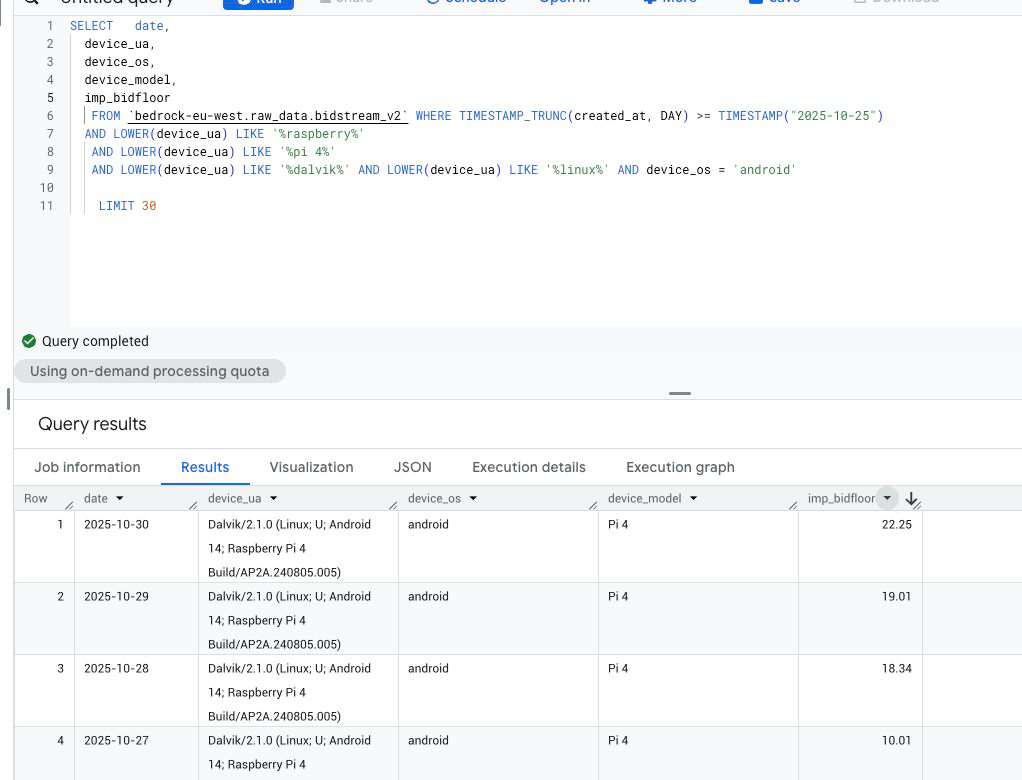
Inspired by the recent IAB Tech Lab workshops and the newest updates around CTV integrity, we looked at our own log-level data at Bedrock Platform. When we looked at our own log-level data, we found Raspberry Pi devices appearing as “CTV” in the bidstream.
We filter this traffic out, and it lands on our IVT lists, but the fact that it shows up at all says a lot about how easy spoofing still is.
A Raspberry Pi is a tiny, cheap hobby computer used for school projects and DIY. It is obviously not a real CTV device, but it can pass as one in parts of the supply chain. This creates wasted spend, inaccurate measurement, and noisy supply paths.
At the IAB Tech Lab Summit, one of the most important updates was the launch of Device Attestation support in the Open Measurement SDK. Here is how it works:
- Device manufacturers provide cryptographic attestations, where supported devices like Apple TV and Fire TV can generate a proof that the device is genuine
- OM SDK can request this attestation when an ad is shown. During measurement, the SDK asks the device to provide an authenticity signal.The proof travels with the measurement data via secure, privacy-preserving version of the IETF Privacy Pass protocol.
- Buyers and verification vendors can check the attestation, independently verifying that the impression came from a real device
A spoofed or emulated device cannot generate a valid manufacturer attestation.
Why this matters?
- Buyers will be able to choose attested CTV inventory only
- Sellers can prove their supply comes from real devices
- Verification vendors get a strong, native authenticity signal
We’re looking forward to wider adoption and the ability to focus spend on verified CTV inventory.
Author: Damian Naglak