Once bidder runs inside the exchange’s cluster, two things bid traffic normally can’t go without become optional: encryption and compression. Encryption costs almost nothing once a connection is open. Compression is the expensive one, and both sides pay for it.
On the bid path, both are there because the traffic crosses the internet. TLS encrypts each request, so the networks it passes through between the exchange and the bidder can’t read or change it. Compression shrinks the bytes you pay to send. Inside one zone of a cluster, the network is private and the bytes are free, so neither reason holds anymore.
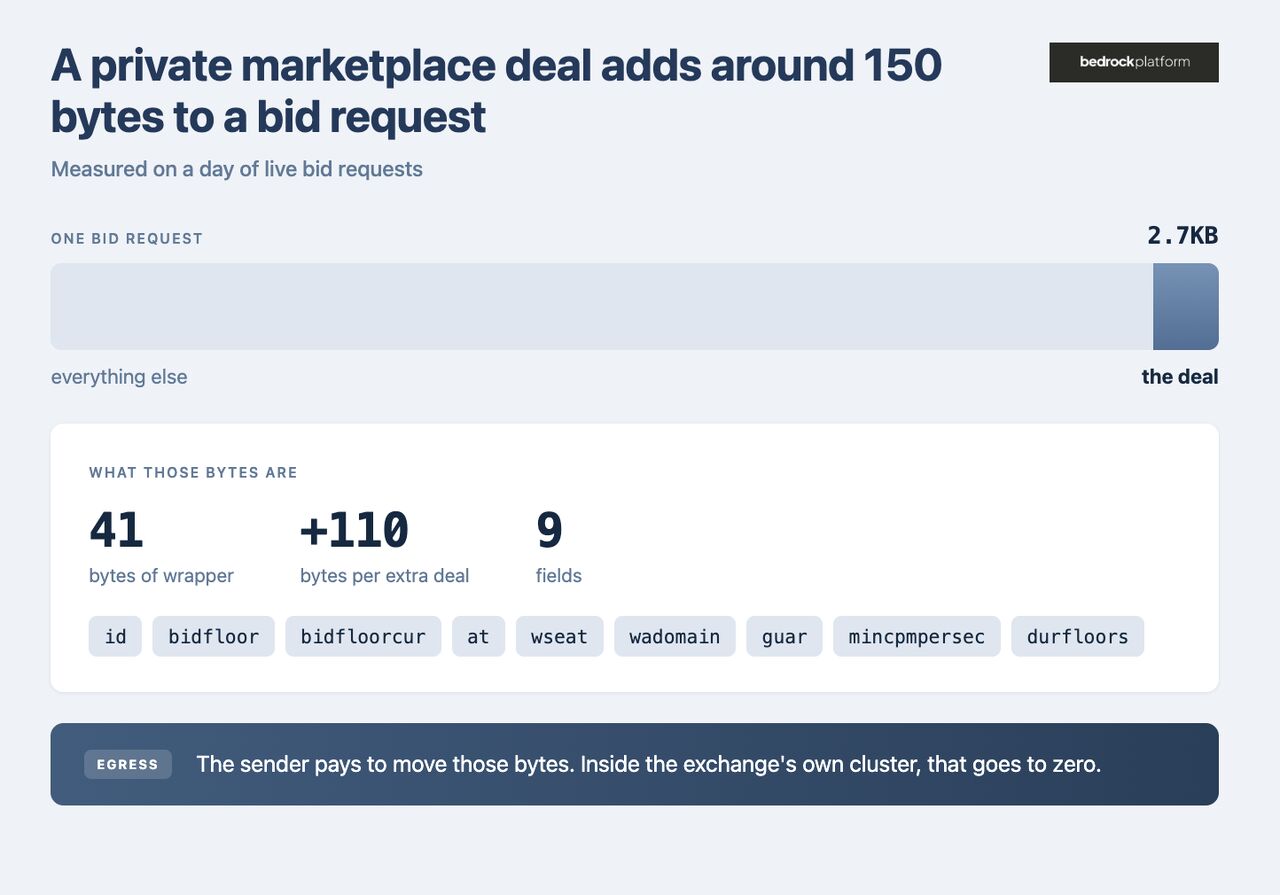
Compression finds text that appears more than once and writes it only once, with a short note wherever it repeats. JSON bid requests repeat a lot, because every message carries the same field names, so a real request shrinks from 2.4 KB to 1.2 KB. gRPC works the same way, with smaller gains: protobuf sends short numbers instead of field names, so there is less to repeat. The price is CPU on both ends: the exchange compresses every request, and the bidder decompresses it.
I tested both on 20,000 real bid requests and real bids, replayed at 5,000 requests per second between an exchange and a bidder in separate containers, with 1% of requests getting a bid. Every combination of TLS on or off and compression on or off, three runs each.
TLS made no measurable difference on warm, reused connections, neither in CPU nor in latency. Its cost is the handshake on a new connection: when 10% of requests opened one, CPU rose 18% on the exchange and 12% on the bidder.
Compression cost about 72 µs of CPU per request on the exchange and 56 µs on the bidder. At a million requests per second, that is around 130 cores, spent shrinking bytes that cross a free network. It trades CPU for network capacity, and inside a zone there is usually plenty of capacity, unless all traffic goes through one node or the two sides sit in different zones.
Co-location is about efficiency and performance. The bid request travels a few meters inside one data centre instead of across the internet, so the answer comes back faster. And once the traffic stays inside the cluster, the exchange and the bidder can stop doing work that only the internet made necessary: guarding every request against networks they don’t control, and shrinking bytes that no longer cost anything to send.