We shipped a containerized bidder inside Index Cloud in April. That solved the pipe. The next question is what flows through it.
At the IAB TechLab Agentic Bootcamp in London a few weeks ago, AAMP 2.0 gave us a direction: Agentic Audiences. Embedding vectors on the bid stream.
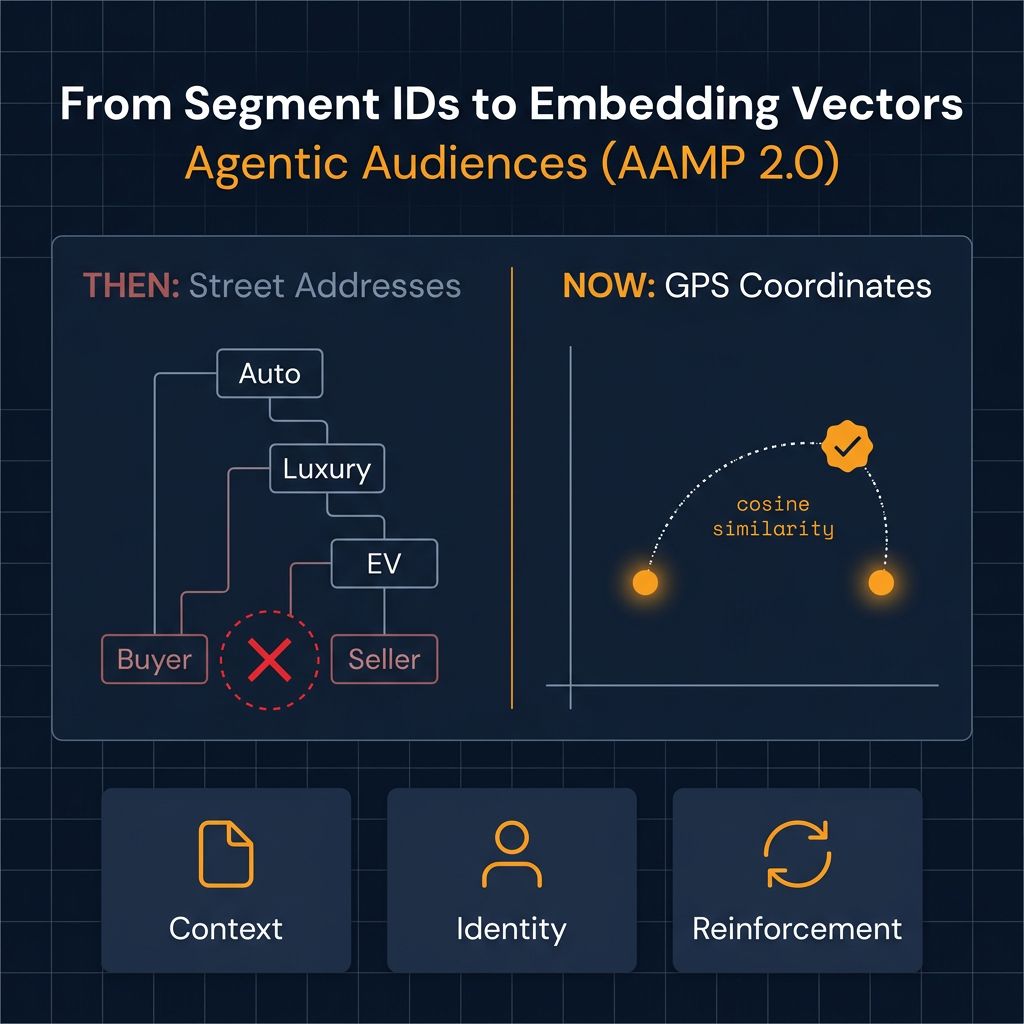
The simplest way I explain it: for twenty years we targeted audiences with street addresses. Publisher labels a user “auto intender, luxury, EV.” DSP looks it up. Both sides agree on the convention or the match breaks.
Embeddings are GPS coordinates. A numerical representation of meaning. The model translates content into concepts, not text into a taxonomy. Up to 1,024 dimensions. The DSP stops asking “is this user in segment 12345?” and starts asking “how close is this user to my campaign objectives?”
Three types in the spec: context, identity, reinforcement. The technology isn’t new. Having a standard to exchange embeddings across every player in the ecosystem is.
Damian Naglak has been publishing excellent technical explainers on the compatibility problem: what breaks when models don’t align across vendors and versions. Worth your time if you want the engineering depth.
I’ll be writing about the strategic layer. Which of these embedding types should a DSP build, which should it consume, and where does the moat sit when every bidder can run cosine similarity?
We’re building something practical now. The containerized bidder gave us room to run new models and methods. We’re not waiting for the ecosystem to align first.
Just because the spec lets you carry an embedding doesn’t mean you know whose map you’re on.
From Segment IDs to Embedding Vectors