
While not a new technology, the use of containerized solutions within adtech has been gaining broader adoption within programmatic for roughly two years. In June 2025, IAB Tech Lab launched its “Containerization Project“,setting out to standardize containerization technology within programmatic.
The core purpose of the initiative, which has since evolved into the Agentic Real Time Framework (ARTF), was “to help the industry develop a more scalable, efficient, and sustainable programmatic ecosystem.“
In November 2025, IAB Tech Lab CEO Anthony Katsur made the AI connection explicit, arguing that agentic workflows demand architecture that treats time as a first-class resource, and that a container-based design does exactly that:
“…minimizing latency, optimizing execution windows, and freeing systems from legacy time constraints so agents can think, act, and transact without delay.”
— Anthony Katsur, CEO, IAB Tech Lab
That shift, from a general infrastructure standard to one purpose-built for agentic AI, drove the evolution of the Containerization Project into ARTF. This opened the door for standards like Model Context Protocol (MCP) and gRPC to work natively inside the bidstream, with ARTF v1.0 designed to cut bid request/response time by up to 80%.
What is containerization?
Before it became an industry buzzword, containerization was simply a way of solving a practical engineering problem, so it’s worth being clear about what it actually does.
Containerization is the packaging of an application’s code, along with all the files, libraries, and dependencies it needs to run, into a single environment that operates in isolation from other local services, while still sharing the same compute. Everything the app needs is packed inside one box, so it runs the same no matter where you open it; your laptop, a data center, the cloud. These boxes are quick to set up, easy to move, and easy to scale up or down without messing with anything else around them.
While initially emerging in the 1970s, containerization went through three decades of iteration before achieving widespread traction across computer circles in 2013. This was thanks to Docker, an open-source platform that makes it easier for developers to build containerized applications.
More recently, the same logic has shaped how AI agents get deployed. Coding agents are routinely run inside containers so they operate with constrained filesystem and network access — isolated from the host machine, but sharing its compute. Docker released a dedicated sandbox product for precisely this use case in early 2026, citing isolation with hard boundaries for developers running agents unattended.
As containerization matured, the adtech industry began exploring how the technology could address some of the specific challenges of programmatic advertising, from latency and scalability to the complexity of running multiple systems across the supply chain.
Setting a standard
IAB Tech Lab’s Containerization Project launched to address “emerging challenges in the development and maintenance of programmatic infrastructure“: the proliferation of specialised bid enrichment and evaluation partners, scaling challenges around live events, fragmented systems, and inconsistent performance.
Its answer was to standardise container technology for OpenRTB, with guidelines for responsible data handling covering bid request/response enrichment, curation signalling, and fraud detection. The goal: let supply chain participants add and swap real-time bidding partners without trading away efficiency and latency.
The evolution of the initiative into ARTF at the end of 2025 took the idea of containerization a step further, with the role of AI agents pushed front and center of the specification.
While the focus remains on efficiency, the updated standard aims to do this by letting any participant within the programmatic bidstream introduce agents directly into the RTB ecosystem, which the IAB Tech Lab still sets out should be deployed within a containerized environment.
What this all means is that, instead of a programmatic transaction having to pass through several layers of infrastructure for each vendor involved, the process happens within a shared computing environment.
This makes the process more efficient, not just in the time taken for transactions to pass through the supply chain, but also in the amount of computing power that has to be used.
And it’s this general concept of “containerized efficiency” that forms the basis for our world-first containerized DSP.
Shipping ads
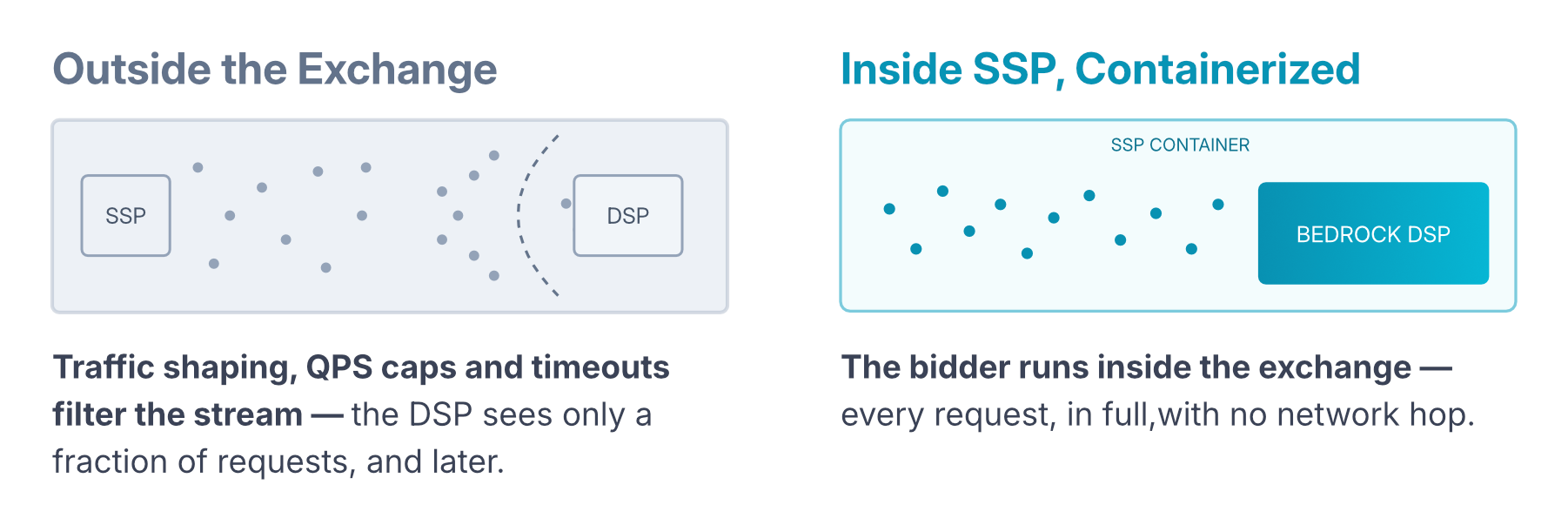
Containerization in adtech didn’t start with demand-side platforms. Supply-side infrastructure has already put containerized algorithms into production for bid enrichment, curation, and fraud detection, laying the groundwork for the shared-compute model that containerized bidding now extends to the demand side.
In April 2026, Bedrock Platform introduced the first containerized bidder, becoming the first media buying platform to deploy within a supply-side platform’s infrastructure: Index Exchange’s Index Cloud, the SSP’s neutral compute environment. By placing a containerized image of our bidder within Index Cloud, we close a gap that has held back the effectiveness of programmatic for a number of years.
Traditional demand-side platform (DSP) infrastructure sits at a distance from the advertising inventory, creating inefficiencies in advertisers’ ability to respond to the availability of these ad slots. Bid requests are limited by throttling (e.g. via QPS caps) and traffic shaping, reducing opportunities to connect with audiences.
Containerizing our platform takes away that distance, and enables direct visibility into supply and near real-time response to ad requests. By removing much of the network latency between the supply and demand sides, more of the available auction time can be allocated to making intelligent bidding decisions rather than transmitting data back and forth.
With the bidding engine co-located in an SSP, there is no longer the need for bid data to be transmitted externally (i.e. egress) across multiple data centers, which in turn can lead to reduced infrastructure costs. These savings are passed on to the advertiser, ultimately making their media budgets go further.
This approach is particularly powerful for connected TV, especially live streaming, where large spikes in concurrent users and the need to respond in real time can put pressure on traditional bidding infrastructure.
The future of media buying will be defined by the ability to effectively leverage data in real time, meeting consumers with immediate relevance, and Bedrock Platform is at the forefront of this evolution.
Interested in hearing more about how containerized bidding could transform the effectiveness of your advertising? Contact us here.
Learn more
To dive deeper into what containerized bidding means for the industry and how programmatic is being reshaped by this model, check out Adweek’s exclusive coverage of Bedrock Platform’s partnership with Index here (subscriptiopn required). For more on the standard driving this shift, see IAB Tech Lab’s Agentic Real-Time Framework.