Latest Article

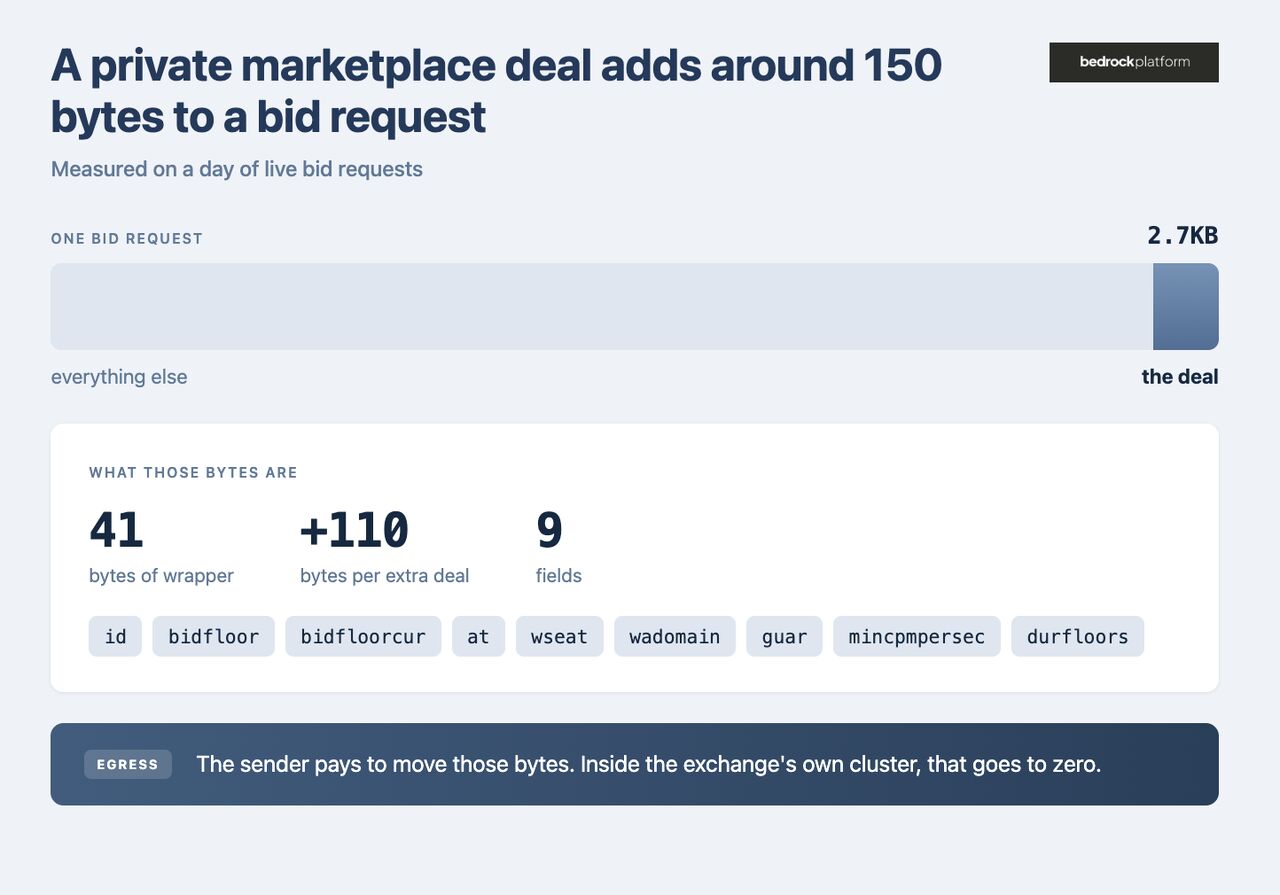
A private marketplace deal adds around 150 bytes to a bid request

Most inventory trades through deals now, and the reasons given are commercial: price, access, guarantees. But what does a deal add to the anatomy of a bid request? One object on the impression, around 150 bytes.A deal travels inside the...

Insights, Updates21 Sep 2026Damian Naglak
3 min read
Read article »
Half the questions in adtech are one question: is this in the list? The list is usually too big to keep, so the answer comes from something that trades a few wrong answers for the space. Has this person already seen the ad? Is this user in the segment? Is this domain on the blocklist? Is this a request the buyer would skip? Frequency capping, targeting, brand safety and traffic shaping ask four different questions with the same shape underneath: a set that's expensive to hold, checked millions of times a second. The answer is older than programmatic, and it comes down to not keeping the list at all. Picture a row of a thousand empty boxes. To put user 4471 on the list, the ID runs through a bit of arithmetic that always points at the same three boxes, say 12, 340 and 807, and those get ticked. Put user 9982 on and it points at 340, 512 and 903, so those get ticked too. Box 340 is now ticked by both of them, and nothing anywhere records which user did it. Checking works the same way. User 4471 points at 12, 340 and 807, all ticked, so 4471 is probably on the list. User 5000 points at 88, 512 and 640, and 88 is blank, so 5000 was definitely never added. Then user 7231 points at 12, 340 and 903, every one of them ticked by somebody else, so the answer comes back yes for a user that was never put on the list. One blank box and the answer is no, for certain. Every box ticked and the answer is probably yes. A user ID written out is 36 characters, so ten million of them is 360 megabytes stored as they are, or 160 packed into raw bytes. Compress that as hard as it can possibly go and it is still 133. The same ten million as ticks is 12 megabytes at one wrong yes in a hundred, 6 at one in ten, 18 at one in a thousand. This only works where a wrong yes is cheap. On a drop list it is. If the filter says a request is on the list when it never was, a few requests go unsent that didn't need to be, and sending fewer was the point anyway. Elsewhere in adtech the same mistake costs more or less depending on where it happens. Blocking a page that was actually fine is the cheap kind of mistake, and skipping someone who hadn't seen the ad yet only costs a bit of reach. Putting someone in an audience they were never in is the expensive one, because money goes on showing them the ad.

Latest articles